Cascade
 gusto35/35
This piece is heavily influenced by the Danish physicist Per Bak and his work on self-organized criticality.
Specifically, it is derivative of his sandpile model. In that model, grains of sand are added to a grid at random locations. If the number of grains at a single location exceeds four, it begins an "avalanche", and pushes one grain out to each cardinal neighbor. This then has the potential of causing a string of avalanches as neighbors also exceed the limit.
His model has a number of interesting characteristics, the most noteworthy being that regardless of initial configuration, it eventually approaches a critical state where the frequency of avalanches sizes follows a power-law relationship. Avalanches of any size are possible, with their frequencies being inversely proportional to the size of the avalanche.
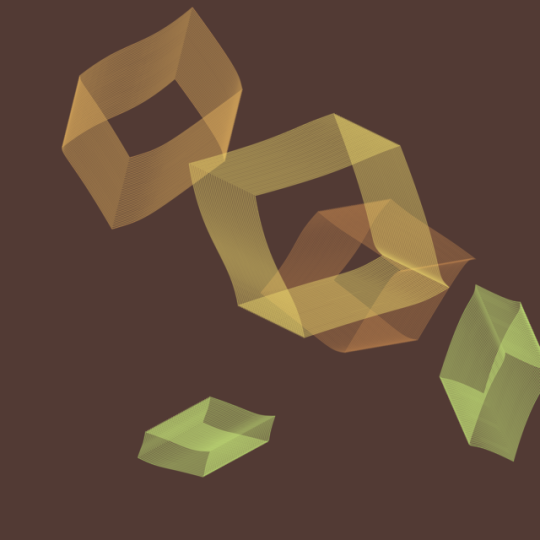
'Cascade' has some important distinctions from this sandpile model.
- Cascades can happen as soon as there are three grains of sand rather than four in a given cell
- Cascades will not flow back into the neighboring location(s) that caused a cell to exceed its threshold
- New grains are introduced at one or more fixed locations rather than randomly
I've provided the following keyboard shortcuts to allow you to explore this system more thoroughly:
'P': pause/play
Right Arrow: Take a single step forward
'S': Restart with new set of sand sources
'I': Restart with new initial sand configuration
'C': Toggle whether or not circles are drawn
'L': Toggle whether or not lines are shown when sand moves
'T': Toggle text indicating how many grains of sand are present